Showing posts with label good shepherd. Show all posts

Saturday, August 6, 2022

The Psalm and Gospel texts for Sunday 7 August 2022

Psalm 10.1-14

Why, Compassionate One, do you stand afar? 

       Why do you hide yourself in hard times?

In arrogance the wicked harass the poor; 

       let them be caught in the schemes they have devised. 

For the wicked praise their [every] inmost desire,

       extort gain and bless those who despise the Creator of All.

The wicked turn up their nose and do not seek [God];

       There is no God in all their thoughts. 

Their ways prosper all the time; 

       your judgements are on high, beyond them;

       all their foes scoff at them. 

They say in their heart, “We shall not be shaken;

       nor [see] evil down through the generations.”

Cursing fills their mouths along with the deceit and oppression; 

       under their tongues are trouble and iniquity.

They sit in ambush in the villages;

in hiding places they murder the innocent.

       Their eyes surveil the vulnerable. 

They lie-in-wait that they ay snatch the poor;

       they search the poor and drag them off in their net. 

They stoop, they crouch, 

       and the vulnerable fall prey through their might. 

They say in their heart, “God has forgotten,

       she has hidden her face, she will never see it.”

Rise up, Faithful God; dear God, lift up your hand;

       forget not the oppressed. 

Why do the wicked despise God,

       and say in their hearts you shall not find out?

You see, you regard trouble and grief, 

       to take [it] into your hands. 

Upon you the vulnerable entrust themselves; 

       to the orphan you have ever [only] been their helper. 


John 10.11-16        “I am the good shepherd. The good shepherd lays down his life for the sheep. The hired hand, who is not the shepherd to whom the sheep do not belong, sees the wolf coming and abandons the sheep and flees, and the wolf snatches them and scatters them. All because a hired hand does not care for the sheep. I am the good shepherd. I know my own and my own know me, just as the Shepherd-Of-All knows me and I know the Shepherd-Of-All. And I lay down my life for the sheep. And I have other sheep that do not belong to this fold: I must bring them as well, and they will listen to my voice, thus there will be one flock, one shepherd.”


Reflection      Here is the secret about bullies. Bullies are people or nations driven by fear to project an image that they are special, superior and sinless. In a bearded effort to cover up their own weakness, smallness and vulnerability, bullies puff themselves up to exert power over others who seem weaker, smaller or more vulnerable.


Remember the swaggering giant Goliath (1 Samuel 17) armored in bronze and fitted with fine forged shield and spear? His looming presence sends the ordinary citizens of Israel fleeing in fear.  Goliath was a bully. We face another Goliath as the Russian superpower deploys masses of money and military might to impose its tyrannical will and exile ordinary Ukrainian citizens.  Here is the thing. When brazen superpowers appear to get away with their barefaced bullying, they boast about being exempt from the will of God.  Cocksure and crowing, “the wicked turn up their noses and do not seek God.” They rant and rave, “We can get away with anything. What need have we for God?”


Meanwhile, drenched in dread the oppressed lament, “We cannot trust anything (the wicked) say, because “cursing fills their mouths along with deceit and oppression…” What are we to believe? What can we do?”  Still, all is not lost if the subjugated do not give up on God. Truth be told, what else can they do? 


A survey of people who identify themselves as nonreligious completed in the United Kingdom in 2018 found that “one in five atheists and agnostics pray on a regular basis in times of personal crisis. Atheists and agnostics reported that the most common reason for them to pray is during a tragedy, but 25 percent of these individuals admitted to also praying for comfort or simply out of loneliness.” **


When we are invaded by a superpower or for any reason come face to face with a bully, there is a good chance we will join the Ukrainians and the psalmist protesting ,  “Why is God not devouring the oppressors and rescuing us?’  Consenting to the reality that we are vulnerable we put our faith in God rather than ourselves. We implore God to take decisive action, “Rise up … lift up your hand”…do not forget us!” 


Unlike bullies who act as if they were gods, the vulnerable never stop calling out to God.  The vulnerable, even the atheist, pray, “Faithful God, “you see, you regard our trouble and grief, take it into your hands.”  Faithful God, we entrust our selves to you.”


Consenting to the reality that we are not in control,  the vulnerable and oppressed are blessed. As Jesus teaches in the gospel according to Matthew, “Blessed are the meek, for they will inherit the earth. Blessed are those who hunger and thirst for righteousness, for they will be filled. Blessed are the pure in heart, for they will see God. “(Matt 5.5,6,8)  Restored to hope, we join the psalmist and our Ukrainian sisters and brothers proclaiming, “Faithful God, to the orphan you have only ever been their helper.” 


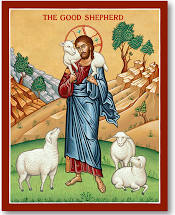
This is the Good News that points to the familiar gospel text known as the Good Shepherd. The sheep depend upon the Good Shepherd.  The Good Shepherd never abandons the sheep, cares for the sheep and knows each one by name. Here is the tricky bit. The Good Shepherd is the Shepherd-of-All.  All means all. The  Shepherd-of-All has other sheep, “that do not (yet) belong to the fold.” The Shepherd-of-All is faithful to the oppressed as well as the oppressors, the Ukrainians as well as the Russians, because the Shepherd-of-All’s superpower is not forged in bronze nor deployed with fear. 


Sending the disciples out “like sheep into the midst of wolves,” (Matt 10.16) like Ukrainians into the midst of Russians, like us into a world fraught with division and violence, Jesus offers counsel, “…have no fear…  for nothing is covered up that will not be uncovered, and nothing secret that will not become known. What I say to you in the dark, tell in the light; and what you hear whispered, proclaim from the housetops. Do not fear those who kill the body but cannot kill the soul… “ 


Here is the uncovered secret about bullies. Bullies are people or nations driven by fear to project an image that they are special, superior and sinless. In a bearded effort to cover up their own weakness, smallness and vulnerability, bullies puff themselves up to exert power over others who seem weaker, smaller or more vulnerable. In other words, bullies and reject their role as sheep assume the posture of Bloated Bad Shepherd.   


Even Jesus is both, a vulnerable sheep known and cared for by the Shepherd-Of-All and Good Shepherd of his flock. We all are meant to be both, good shepherds extending our lives for the benefit of others and vulnerable sheep, known and cared for by the Shepherd-Of-All. The thing is, we cannot be one without also being the other. Sheep and Good Shepherd are two sides of one coin. Power held in check by humility. 


I can think of no better counsel for the Ukrainians and every other person subject to the vulgar misuse of power by bullying tyrants who deny they are sheep. “Do not fear those who would kill the body but cannot kill the soul.” Though bombastic bullies may polish their armor and sharpen their tongues, we need not be afraid because as sheep we entrust ourselves to the One who has “ever only been our helper,” the Shepherd-of-All who knows our name and cares for us as we muddle along in the midst of bullies while doing our best to be good shepherds of others. 


Have a listen to James Finley speaking about Sacred Moments of Vulnerability by clicking on image near the upper right of your screen. 


**https://www.theguardian.com/world/2018/jan/14/half-of-non-believers-pray-says-poll


Saturday, April 24, 2021

Gospel text for Sunday 25 April 2021


John 10:11-18        Jesus said, “I am the good shepherd. The good shepherd lays down his life for the sheep. The hired hand, who is not the shepherd and does not own the sheep, sees the wolf coming and leaves the sheep and runs away—and the wolf snatches them and scatters them. The hired hand runs away because a hired hand does not care for the sheep. I am the good shepherd. I know my own and my own know me, just as the Father knows me and I know the Father. And I lay down my life for the sheep. I have other sheep that do not belong to this fold. I must bring them also, and they will listen to my voice. So there will be one flock, one shepherd. For this reason the Father loves me, because I lay down my life in order to take it up again. No one takes it from me, but I lay it down of my own accord. I have power to lay it down, and I have power to take it up again. I have received this command from my Father.”


Reflection       How are we to respond to Jesus’ willingness to lay down his life so that we all may be one? How are we to respond to a leader who does not run away or toss us under the bus when all hell breaks loose and life erupts out of control? I believe the answer is simple (not easy). We must do everything we possibly can to affirm our unity with all people.


Doing everything we possibly can begins with remembering who and whose we are. We understand that all people “are made in the image of God,”  and that “we are free to make choices: to love, to create, to reason, and to live in harmony with creation and with God.” (BCP 845)  Like the Good Shepherd we “have the power to lay our lives down… by our own accord.” In other words, we are free to care for one another. 


Doing everything we possibly can means we respond to Jesus’ call “that we all may be one” by respecting the dignity of every human being and loving our neighbor as ourself. It means we erase the redlines and remove the fences that falsely separate us.  It means doing whatever it takes to insure the assumptions and actions that deny the shared humanity of George Floyd and Dereck Chauvin are dismantled. 


Here I must confess I did not celebrate when I heard the news of Mr. Chauvin’s conviction because one man is dead and another man’s life is destroyed, two families are devastated and our country is divided over who is the trespasser and who the trespassed. 


Yes. Holding a man to account for his actions is imperative and it is not enough to allay the fear of fathers giving their black sons ‘the talk’ about how to protect themselves when confronted by white authority. It is not enough to  quiet the fear of mothers teaching their white daughters how to walk through parking lots and certain places and not be seen as vulnerable. Holding a man to account for his behavior is necessary and not sufficient to transform the consciousness of people who experience one another as threats. 


Secular law holds us accountable for wrongful social behavior.  It judges our up close, personal, blow by blow actions and their consequence. Secular law responds with equivalent retaliation, tit for tat, an eye for an eye.  By contrast, God’s law assumes a hundred thousand feet above the ground perspective. It disarms every appearance of division to declare our shared humanity. In the words of the parable of the Good Shepherd, “so there will be one flock, one shepherd.” 


God’s law demands a reckoning for Mr. Floyd’s killing and Mr. Chauvin’s conviction.  This has nothing to do with counting coup or political advantage. God’s law requires nothing less than the transformation of our individual and collective consciousness.


When we set aside our pride, politics and opinions we are free to rise to the God’s eye point of view.  From the hundred thousand feet above the ground perspective we see that we are “one flock, one shepherd.” With our minds risen to the heights of our hearts we naturally choose to use our freedom to love and live in harmony.  This is the transformation of consciousness God’s law demands as a reckoning for Mr. Floyd’s killing and Mr. Chauvin’s conviction. We must do everything we possibly can to affirm our unity with all people.


If you found this post to be meaningful please share by clicking on icons  below. Thank you.


Thursday, March 19, 2020

Psalm for Fourth Sunday in Lent 22 March 2020

Psalm 23 
 The Lord is my shepherd; *
I shall not be in want.
 He makes me lie down in green pastures *
and leads me beside still waters.
 He revives my soul *
and guides me along right pathways for his Name's sake.
 Though I walk through the valley of the shadow of death,
I shall fear no evil; *
for you are with me;
your rod and your staff, they comfort me.
 You spread a table before me in the presence of those who trouble me; 
you have anointed my head with oil,
and my cup is running over.
 Surely your goodness and mercy shall follow me all the days of my life, 
and I will dwell in the house of the Lord for ever.

Reflection        No doubt the most beloved of the 150 psalms is the 23rd. Children and adults recall to heart the words, The Lord is my shepherd, I shall not want. And even though many folks choose the twenty third psalm for their memorial and celebration of life service, I believe it is a beautiful description of how we are to live our lives every day.

A shepherd cares for the safety and welfare of the sheep, even laying his life down for the good of them. When used as a metaphor for God, we understand God as a shepherd that is in charge of our lives and is committed to our safety, nourishment and thriving.

As our psalmist sings, with God as my shepherd, I shall not want. Wow. What a declaration of faith. With God I can lack nothing, not even in the midst of a coronavirus outbreak when it is nearly impossible to buy tuna fish or frozen dinners, hand sanitizer or toilet paper. Being with God I need nothing else.

The Lord is my shepherd…. I shall lack in nothing. No matter what is happening around me I shall lack nothing because with God I am calm,  God leads me to still waters and green pastures. I thrive. With God my soul is revived and even when I stumble through difficult times and feel afraid, being wrapped in God’s protection I am comforted.

When my mind races with grave imaginings that evil and enemies surround me, that dreadful things are happening everywhere I turn and the news is nothing but distressing, God blesses me with the holy oil of mercy and I am stunned by God’s extravagant love. 

Yes, God’s goodness and mercy follow me all the days of my life because God is faithful. But once again we are reminded that grace is not cheap. God’s blessing demands our faithful response. Every minute of every hour we must choose to “live in the house of the Lord for ever,” which is to say we must choose to live in faith, not fear.  God’s proverbial house is one of faith, hope and love. Not fear. The sure and certain way to live in God’s house of faith, hope and love is to claim with every ounce of our being, “The Lord is my shepherd, I shall not want.” “ I choose to live in the house of faith, hope and love. "

God’s goodness and mercy is with us as we tread the uncharted waters of the coronavirus and dramatic social and economic change. The Lord is our shepherd. We shall not be afraid because we choose to live in the house of faith, hope and love.


If you found this post to be meaningful please click on icons below to share. Thank you.

Saturday, April 21, 2018

Gospel text for 4th Sunday of Easter 22 April 2018


John 10:11-18        Jesus said, “I am the good shepherd. The good shepherd lays down his life for the sheep. The hired hand, who is not the shepherd and does not own the sheep, sees the wolf coming and leaves the sheep and runs away—and the wolf snatches them and scatters them. The hired hand runs away because a hired hand does not care for the sheep. I am the good shepherd. I know my own and my own know me, just as the Father knows me and I know the Father. And I lay down my life for the sheep. I have other sheep that do not belong to this fold. I must bring them also, and they will listen to my voice. So there will be one flock, one shepherd. For this reason the Father loves me, because I lay down my life in order to take it up again. No one takes it from me, but I lay it down of my own accord. I have power to lay it down, and I have power to take it up again. I have received this command from my Father.”  

Reflection       When we listen carefully to Jesus’ words, “I am the good shepherd. I know my own and my own know me, just as the father knows me and I know the father. I lay down my life for the sheep,” we hear him making a three part declaration. The first part of his declaration is; I am the good shepherd. Jesus knows who he is. Second part; Jesus acknowledges the mutual connection of his relationship with those whom he knows and who know him as well as the mutuality of his relationship with God. So the second part of Jesus’ declaration is about connection and belonging. The third part of Jesus’ declaration is about personal responsibility, “I lay down my life for the sheep.” Jesus’ life is not only for him self, it is also for others. He holds his individual life lightly, he does not cling to it.

When we know who we are and claim the mutuality of our relationships in community and in God, we naturally take responsibility for the care of one another,  even though this is risky business, even though it may cost us our life as we know it.

If life is all about me then every one else and everything else is a potential obstacle or problem and it is no wonder we live in a chronic state of anxiety and defensiveness. Viewing the world from this perspective, connection, belonging and community fail. Rather than stand in the way of an active shooter we stand in fear and fail to enter a school to protect endangered children. We spend $16.8 trillion dollars to bail out big banks insuring their CEOs receive their bonuses and fail to feed the 49 million Americans who lack the means to get enough nutritious food each day.* When we view the world exclusively from the ‘its all about me” perspective we fail to show up, connect and take responsibility for our community.The result of doing this, God’s kingdom is not come because God’s kingdom requires all of us in our conjoined humanity.

What then is the solution? We must join Jesus in making our own three part declaration; claiming who we are, acknowledging our connection and belonging, and taking personal responsibility for the good of one another. Here is my declaration. 

I am here. I am wholly present. The actions you can count on me for are creating opportunities for you to be here too. I will notice and affirm God’s presence in and of, with and for you. The difference I now see I can make is making God’s Presence known, making God’s kingdom come. Will you join me in my possibility? Will you join me in taking the risk to stand up for connection, belonging and community? Will you join me in making God’s kingdom come? 

If you found this post to be meaningful please share by clicking on icons below. Thank you.


*https://mashable.com/2016/07/14/child-hunger-united-states/#pp4gMW3PIaqM

Saturday, May 6, 2017

Gospel text for 4th Sunday of Easter 7 May 2017

John 10:1-10        Jesus said, “Very truly, I tell you, anyone who does not enter the sheepfold by the gate but climbs in by another way is a thief and a bandit. The one who enters by the gate is the shepherd of the sheep. The gatekeeper opens the gate for him, and the sheep hear his voice. He calls his own sheep by name and leads them out. When he has brought out all his own, he goes ahead of them, and the sheep follow him because they know his voice. They will not follow a stranger, but they will run from him because they do not know the voice of strangers.” 

Jesus used this figure of speech with them, but they did not understand what he was saying to them. So again Jesus said to them, “Very truly, I tell you, I am the gate for the sheep. All who came before me are thieves and bandits; but the sheep did not listen to them. I am the gate. Whoever enters by me will be saved, and will come in and go out and find pasture. The thief comes only to steal and kill and destroy. I came that they may have life, and have it abundantly.”

Reflection     Do you remember this Easter morning story? Early in the morning on the first day of the week Mary Magdalene remained alone at Jesus’ empty tomb crying? At first she didn’t recognize him,  but when he  called her by name in the depths of her heart Mary recognized Jesus’ voice? (John 20.1, 14-16) I believe this story points beyond the physical hearing of voices on the outside to the deep interior place where we “hear and know” what is right and good and true. 

Or the much loved story of two disciples leaving Jerusalem recounting the torture and death of their friend Jesus, when the risen Christ appeared to them as they remembered the words of holy scripture and how  Jesus took bread and blessed, broke and gave it to them?  Then their eyes were opened and they recognized Him; and He vanished from their sight. They said to one another, “Were not our hearts burning within us while He was speaking to us on the road.”( Luke 24.13-25)

In  John’s text we listen to Jesus’ parable,  “… the sheep hear his voice. He calls his own sheep by name and leads them out. When he has brought out all his own, he goes ahead of them, and the sheep follow him because they know his voice.”

Is it too bold to assume that every one of us has had the experience of something stirring inside us, our hearts burning or perhaps a still, small voice, “Don’t do that?” Or a nagging inner sense, “I really need to call Harold.” Or maybe you caught yourself saying, “Something told me….” or “I knew better,” or that just felt right or wrong, or I knew he was telling the truth or I knew she was lying.

Jesus invites the disciples and us to pay attention to the voice we recognize within ourselves, the voice of the Good Shepherd who knows us deeply and intimately, the still small voice within that leads us out of temptation and “guides us along right pathways.” Jesus encourages us to rely on the voice of the Good Shepherd within to comfort us in our dark times and guide us when faced with evil. 

Unlike rulers, leaders and teachers who steal and kill, manipulate and destroy for their own gain, the interior voice of the Good Shepherd may be trusted to guide and direct us toward life in abundance. 

If you are wondering what you can do to better hear the voice of the Good Shepherd, consider trying a practice of  silence and deep listening, centering prayer, Christian meditation or walking silently alone on the desert. Even ten minutes every day will tune your inner 'hearing.' Join us for Centering Prayer Wednesdays as 2pm. 


If you found this post to be meaningful please share by clicking on icons below. Thank you.

Monday, April 23, 2012

Gospel text for Sunday 29 April 2012

John 10:11-18
Jesus said, "I am the good shepherd. The good shepherd lays down his life for the sheep. The hired hand, who is not the shepherd and does not own the sheep, sees the wolf coming and leaves the sheep and runs away-- and the wolf snatches them and scatters them. The hired hand runs away because a hired hand does not care for the sheep. I am the good shepherd. I know my own and my own know me, just as the Father knows me and I know the Father. And I lay down my life for the sheep. I have other sheep that do not belong to this fold. I must bring them also, and they will listen to my voice. So there will be one flock, one shepherd. For this reason the Father loves me, because I lay down my life in order to take it up again. No one takes it from me, but I lay it down of my own accord. I have power to lay it down, and I have power to take it up again. I have received this command from my Father."