Showing posts with label follow. Show all posts

Friday, January 22, 2021


 Mark 1:14-20       After John was arrested, Jesus came to Galilee, proclaiming the good news of God, and saying, “The time is fulfilled, and the kingdom of God has come near; repent, and believe in the good news.”

As Jesus passed along the Sea of Galilee, he saw Simon and his brother Andrew casting a net into the sea—for they were fishermen. And Jesus said to them, “Follow me and I will make you fish for people.” And immediately they left their nets and followed him. As he went a little farther, he saw James son of Zebedee and his brother John, who were in their boat mending the nets. Immediately he called them; and they left their father Zebedee in the boat with the hired men, and followed him.

Reflection        What is good news for some; Democratic control of congress, limited government, mountains of fresh snow, is bad news for others; Democratic control of congress, limited government, mountains of fresh snow. Good news, bad news, it is a matter of perspective, right?


The first sentence of the Markan text reads, "The beginning of the euangelion (good news) of Jesus the Christ, son of God.” Just fourteen sentences later Jesus bursts onto the scene in Galilee preaching the euangelion (good news), "The time is fulfilled, and the kingdom of God is at hand; repent, and believe in the euangelion (believe the good news).” 


Euangelion is not your run of the mill, equivocal “good news.” In all four gospels  euangelion is more than news that satisfies our personal, social, political or religious preferences because this euangelion, this good news, is for everyone. Clearly, the English words “good news” are insufficient to communicate the full meaning and magnitude of Jesus’ euangelion. 


A little history. The Roman emperors of Jesus’ time understood themselves to be lords and saviors of the world. Their speeches (state of the union addresses) or messages (pastoral letters) were called evangelium which was the Latin equivalent of the Greek euangelion and meant, whatever comes from the emperor is more than a mere bit of news. The people were to believe that the emperor’s news would change the world for the better. The emperor’s words were good news for all. 


At issue is something truly remarkable. It was beyond bold for the writers of the four gospels to appropriate the word evangelium and use  euangelion in conjunction with the itinerant teacher Jesus because this word is rife with authority and reserved for the emperors’ communication. By appropriating this word the gospel writers are basically telling the people then and now, “The political officials who act as if gods, are making illegitimate claims. They do not have the power to save you or the world. Take another look. The power to change the world for the better is solely the purview of God.” 


In the Markan text immediately after his cousin John is arrested Jesus arrives on the scene in Galilee, “proclaiming the euangelion of God saying, "The time is fulfilled, and the kingdom of God has come near; repent, and believe…” This is truly euangelion. Regardless of whether the news of the day delights or disturbs us, the really, really, really good news is, God is here now. This news is more than words scratched on papyrus or signed executive orders. It is the living, breathing Word of God incarnate, Jesus who actually enters and transforms the world. Jesus, the Son of God is here, now, present and active. And the world is better for it. 


In light of the Word, God present, the empty promises of politicians are exposed. The idolatry and false piety of religious officials are revealed. Whoever recognizes Jesus as the Living Word of God will reject the secular and religious officials’ false claims to power. They will change their minds and follow the way of Jesus, the really, really, really unequivocal good news, euangellion.

Perhaps this is why Mark’s gospel reads like a boldly edited action film. One minute Jesus’ cousin John is arrested and immediately Jesus is proclaiming euangelion, news that will change the world for the better. The lectionary’s translation of the Greek text reads, “The kingdom of God is near.” I believe a better translation of the Greek engizō is, “now present.” (Strongs G1448).  The kingdom of God is now present and that makes everything better. 

The writer of Mark’s gospel wastes no time setting the stage for Jesus’ apocalyptic entry. Jesus is going to change the world for the better and he needs help now, so he goes fishing for people. Apparently without hesitation Simon and his brother Andrew turn away from their livlihood and follow the way of Jesus. Wait another minute and Jesus catches another pair of brothers, James and John, who immediately stand up, turn away from their attachment to the past, their father,  and follow Jesus. 

We have to admit, this story is not very convincing which makes me think the writer was using words to point to something more than historical events. In some inexplicable way encountering the Word God as embodied in Jesus, ordinary people like Simon, Andrew, James, John and us are emboldened to do the impossible; to repent, to put down our old way of living, turn around and follow the way of Jesus.

And there we have it. It is not enough to pray for our nation and the world. It is not enough to write about a “more perfect Union” wherein justice, domestic tranquility, and the general welfare are secured. Like Simon and Andrew, James and John we must put feet on our words, on God’s Word, following the way of Jesus. 

How many times must Jesus cast his net before everyone one of us catches the euangelion, the apocalyptic good news of the grace of God available right here, right now for all people? What will it take for us to put feet on your words, to stand up and walk with Jesus and be the euangelion for all people? 

If you found this post to be meaningful please share by clicking on icons below. Thank you. 

Thursday, March 19, 2020

Psalm for Fourth Sunday in Lent 22 March 2020

Psalm 23 
 The Lord is my shepherd; *
I shall not be in want.
 He makes me lie down in green pastures *
and leads me beside still waters.
 He revives my soul *
and guides me along right pathways for his Name's sake.
 Though I walk through the valley of the shadow of death,
I shall fear no evil; *
for you are with me;
your rod and your staff, they comfort me.
 You spread a table before me in the presence of those who trouble me; 
you have anointed my head with oil,
and my cup is running over.
 Surely your goodness and mercy shall follow me all the days of my life, 
and I will dwell in the house of the Lord for ever.

Reflection        No doubt the most beloved of the 150 psalms is the 23rd. Children and adults recall to heart the words, The Lord is my shepherd, I shall not want. And even though many folks choose the twenty third psalm for their memorial and celebration of life service, I believe it is a beautiful description of how we are to live our lives every day.

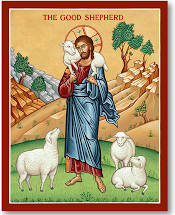
A shepherd cares for the safety and welfare of the sheep, even laying his life down for the good of them. When used as a metaphor for God, we understand God as a shepherd that is in charge of our lives and is committed to our safety, nourishment and thriving.

As our psalmist sings, with God as my shepherd, I shall not want. Wow. What a declaration of faith. With God I can lack nothing, not even in the midst of a coronavirus outbreak when it is nearly impossible to buy tuna fish or frozen dinners, hand sanitizer or toilet paper. Being with God I need nothing else.

The Lord is my shepherd…. I shall lack in nothing. No matter what is happening around me I shall lack nothing because with God I am calm,  God leads me to still waters and green pastures. I thrive. With God my soul is revived and even when I stumble through difficult times and feel afraid, being wrapped in God’s protection I am comforted.

When my mind races with grave imaginings that evil and enemies surround me, that dreadful things are happening everywhere I turn and the news is nothing but distressing, God blesses me with the holy oil of mercy and I am stunned by God’s extravagant love. 

Yes, God’s goodness and mercy follow me all the days of my life because God is faithful. But once again we are reminded that grace is not cheap. God’s blessing demands our faithful response. Every minute of every hour we must choose to “live in the house of the Lord for ever,” which is to say we must choose to live in faith, not fear.  God’s proverbial house is one of faith, hope and love. Not fear. The sure and certain way to live in God’s house of faith, hope and love is to claim with every ounce of our being, “The Lord is my shepherd, I shall not want.” “ I choose to live in the house of faith, hope and love. "

God’s goodness and mercy is with us as we tread the uncharted waters of the coronavirus and dramatic social and economic change. The Lord is our shepherd. We shall not be afraid because we choose to live in the house of faith, hope and love.


If you found this post to be meaningful please click on icons below to share. Thank you.

Thursday, September 5, 2019

Gospel text for Sunday 8 September 2019

Luke 14:25-33        Now large crowds were traveling with Jesus; and he turned and said to them, "Whoever comes to me and does not hate father and mother, wife and children, brothers and sisters, yes, and even life itself, cannot be my disciple. Whoever does not carry the cross and follow me cannot be my disciple. For which of you, intending to build a tower, does not first sit down and estimate the cost, to see whether he has enough to complete it? Otherwise, when he has laid a foundation and is not able to finish, all who see it will begin to ridicule him, saying, `This fellow began to build and was not able to finish.' Or what king, going out to wage war against another king, will not sit down first and consider whether he is able with ten thousand to oppose the one who comes against him with twenty thousand? If he cannot, then, while the other is still far away, he sends a delegation and asks for the terms of peace. So therefore, none of you can become my disciple if you do not give up all your possessions.”

Reflection        The cost of responding to Jesus’ invitation to discipleship, the cost of actually living the Way of Jesus, insists we break away from the past and from all attachments that would stand between us and living in imitation of Jesus. In his 1937 classic, The Cost of Discipleship,  the German theologian Dietrich Bonhoeffer writes,

"The price we are having to pay today in the shape of the collapse of the organized church is only the inevitable consequence of our policy of making grace available to all at too low a cost. We gave away the word and sacraments wholesale, we baptized, confirmed, and absolved a whole nation without condition. Our humanitarian sentiment made us give that which was holy to the scornful and unbelieving…  But the call to follow Jesus in the narrow way was hardly ever heard.”**

Which begs the question, what is ‘the narrow way” of following Jesus? I believe it is picking up the cross and imitating the life of Jesus. And what does that mean? It means, like Jesus we must be willing to suffer or sacrifice for the sake of others. You see, Jesus did not come as a warrior king, intent on fighting the purveyors of evil and oppression and winning. Jesus did not come as a politician seeking office to govern the land and legislate change and take over. Jesus did not even come as a stakeholder in Judaism or the Roman Empire. Jesus came as a powerless peasant willing to empty himself of all attachments in order to serve and to suffer for the good of others. This is the cost of discipleship, our whole life.

It is in our willingness to advance benefits for others even at our own expense; to feed the hungry, house the homeless, give refuge to the stranger, comfort the mourning and heal the sick that we are the bodily presence of Christ in the world. If we claim to be disciples of Jesus then we too must empty ourselves of attachments, in Jesus’ words, “hate father and mother, wife and children, brothers and sisters, yes, and even life itself,”  in order to serve and to suffer for the good of others. This is the cost of discipleship.

Doing good works has its shadow side too. There is always the temptation to elevate ourselves. “Look at me. Do you see all the good I am doing? I help the homeless at Sr. José, I serve the refugees at Casa Alitas, I help my neighbors, I bring groceries to the food pantry…” The good works that we do are not intended to point to ourselves. They are meant to reveal Divine Presence and fulfill Jesus’ law of love for all people. By our self-emptying, our giving away of ourselves for others, we are the living Body of Christ and we reveal the Way of the cross to the world, and, there is absolutely nothing easy about this. The cost of discipleship is our life.

**Bonhoeffer, Dietrich. The Cost of Discipleship. New York: Macmillan, 1966. BT 380.B66 1966.

If you found this post to be meaningful please share by clicking on icons below. Thank you. 


Friday, October 12, 2018

Gospel text for Sunday 14 October 2018


Mark 10:17-31       As Jesus was setting out on a journey, a man ran up and knelt before him, and asked him, “Good Teacher, what must I do to inherit eternal life?” Jesus said to him, “Why do you call me good? No one is good but God alone. You know the commandments: ‘You shall not murder; You shall not commit adultery; You shall not steal; You shall not bear false witness; You shall not defraud; Honor your father and mother.’” He said to him, “Teacher, I have kept all these since my youth.” Jesus, looking at him, loved him and said, “You lack one thing; go, sell what you own, and give the money to the poor, and you will have treasure in heaven; then come, follow me.” When he heard this, he was shocked and went away grieving, for he had many possessions.

Then Jesus looked around and said to his disciples, “How hard it will be for those who have wealth to enter the kingdom of God!” And the disciples were perplexed at these words. But Jesus said to them again, “Children, how hard it is to enter the kingdom of God! It is easier for a camel to go through the eye of a needle than for someone who is rich to enter the kingdom of God.” They were greatly astounded and said to one another, “Then who can be saved?” Jesus looked at them and said, “For mortals it is impossible, but not for God; for God all things are possible.”
Peter began to say to him, “Look, we have left everything and followed you.” Jesus said, “Truly I tell you, there is no one who has left house or brothers or sisters or mother or father or children or fields, for my sake and for the sake of the good news, who will not receive a hundredfold now in this age—houses, brothers and sisters, mothers and children, and fields with persecutions—and in the age to come eternal life. But many who are first will be last, and the last will be first.”


Reflection        Can you hear Jesus scratching his head when the young man protests, “I have kept all of the commandments;” (Jesus) “You have kept them? You have depended upon yourself to be righteous and upstanding? You really think you have done this by your own wit and will? Poor young man, you lack one thing. Humility. Go and sell all that you own then come and follow me.” In other words, if you want to find eternal life you must admit your dependence on God with you. 

And if this shocked the young man who was living in the Ancient Near East, a collectivist culture that stresses the importance of community and interdependence of the people, how much more unfathomable is this for those of us who have been raised in a Post Enlightenment culture that understands people as independent and autonomous. How can we digest Jesus’ counsel when the world around us makes it clear that being dependent upon others is embarrassing if not down right shameful? We are supposed to be self-reliant and anyone who is not ought to stop making excuses and “pull themselves up by their boot straps.”

By our wit and will we are supposed to solve our own problems and accomplish our five year, ten year and lifetime goals. We are praised for being self-reliant, self-sufficient and self-made. All these are respectable qualities except we fail to notice one thing, they separate us from God and one another.  

And so Jesus looks at us with love and says, “How hard it will be for those who have wealth to enter the kingdom of God!” As long as we hold fast to our self-determination we are essentially setting our selves apart and claiming sovereignty that belongs to God alone.  Being thus bloated with our selves it is no wonder we do not experience God with us. This is why Jesus counsels the young running man and us to sell everything and follow him. 

Here is the thing. Most of us get stuck on the first part of Jesus’ instruction. “Sell everything.” Really? Not all of us are cut out to make vows of poverty and live in monasteries. So we join the running man grieving and set out again on our own thereby completely missing Jesus’ second instruction, “follow me.”

To follow means to come after, to subordinate our selves to someone or something else, to accept another’s authority as guide or teacher.* When we consent to follow, we affirm our interconnected interdependence which by definition means we stop clinging to our culturally prescribed identities as self-reliant, self-sufficient, self-made and self-determining creatures. We sell all that baggage and follow Jesus, the teacher, who shows us that the way of eternal life is all about being in unselfish, magnanimous, open handed relationships which are possible when we put our confidence in God with us, rather than our selves.  

I believe life is a story and we get to choose whether we want our story to be “with God” or not. If we choose “with God” life, we must get rid of whatever separates us from God. Some of the  culprits are our inordinate desires for safety and security, affection and esteem, power and control. If we choose “with God” life we must grow beyond the presumption of being self-reliant, self-sufficient, self-made and self-determining and affirm our purpose in the world with and for one another. When we choose a “with God” life story we realize, it is not all about me, it is all about we. It is not all about mine, it is all about ours. Our “with God” life story is a story of radical inclusiveness;  life in and of, with and for the well-being of all people. What story do you choose?

If you found this post to be meaningful please share by clicking on icons below. Thank you.


Saturday, February 13, 2016

Gospel text for Sunday 14 February 2016

Luke 4:1-13        After his baptism, Jesus, full of the Holy Spirit, returned from the Jordan and was led by the Spirit in the wilderness, where for forty days he was tempted by the devil. He ate nothing at all during those days, and when they were over, he was famished. The devil said to him, "If you are the Son of God, command this stone to become a loaf of bread." Jesus answered him, "It is written, 'One does not live by bread alone.'"
Then the devil led him up and showed him in an instant all the kingdoms of the world. And the devil said to him, "To you I will give their glory and all this authority; for it has been given over to me, and I give it to anyone I please. If you, then, will worship me, it will all be yours." Jesus answered him, "It is written,'Worship the Lord your God,
and serve only him.'"Then the devil took him to Jerusalem, and placed him on the pinnacle of the temple, saying to him, "If you are the Son of God, throw yourself down from here, for it is written,'He will command his angels concerning you,to protect you,'
and ‘On their hands they will bear you up, so that you will not dash your foot against a stone.'"Jesus answered him, "It is said, 'Do not put the Lord your God to the test.'" When the devil had finished every test, he departed from him until an opportune time.

Reflection        While in the wilderness Jesus demonstrates the discernment of Spirits. What do we mean by discernment? A dictionary definition  of discernment is “the quality of being able to grasp and comprehend what is obscure; to distinguish and select what is true, appropriate or excellent; to penetrate beyond the obvious.” This definition of discernment is all about what we are able to do. We are the active agents. It is about us grasping, penetrating and mastering the situation.
The definition of discernment found in Ignatius of Loyola’s Spiritual Exercises* is, “…our willingness to look at and appreciate the signs of God’s love for us and, in response to the voice of the Spirit of God, follow where the Spirit leads.”  The tone is quite different. Rather than grasping, penetrating or mastering we are willing, listening, and following. God is the active agent. We are willing to respond to God through the leading of the Spirit. I believe this is what is happening with Jesus in the wilderness.

Jesus allows the Spirit of God to lead him to the wilderness (metaphor for the movements of his mind and his heart). The story continues with the devil tempting Jesus to grasp, penetrate or  master his situation rather than follow the Spirit of God. If you are the son of God, prove it by satisfying your hunger. If you are the son of God, do something to improve the social and political situation in the world attain fame. If you are the son of God, leap from the top of this temple and prove you are indestructible.  

Each time the devil taunts, tempts and tries to undermine Jesus’ intention to follow the Spirit of God, Jesus returns to the word of God. When inclined to satisfy his hunger Jesus remembers the counsel to the Israelites in the Hebrew scripture and replies, “I do not live by bread alone;” the word of God is the source of my sustenance and life. (Deut 8.2-3)

When tempted to make an idol of social and political power Jesus remembers Moses’ instructions to the Israelites, (Deut 6.13-14) and replies,“Worship the Lord your God and serve only God.” Finally, when provoked to challenge God’s faithfulness, again, rather than relying on himself Jesus listened to the words of Holy Scripture and replied, "You shall not put the LORD your God to the test…” (Deut 6.16) 

Jesus listens to the word of God and willingly follows the lead of the Spirit of God. Lent is our wilderness time, an opportunity for us to do likewise; sacrifice our inclination to grasp, penetrate and master our situations and instead be willing to listen and follow the lead of the Spirit of God.

*The Spiritual Exercises of St. Ignatius, as translated by Louis J. Puhl,S.J.


If you found this post meaningful, please share by clicking on icons below. Thank You.

Monday, January 9, 2012

Gospel Text for Sunday, 15th of January 2012


John 1:43-51
The next day Jesus decided to go to Galilee. He found Philip and said to him, "Follow me." Now Philip was from Bethsaida, the city of Andrew and Peter. Philip found Nathanael and said to him, "We have found him about whom Moses in the law and also the prophets wrote, Jesus son of Joseph from Nazareth." Nathanael said to him, "Can anything good come out of Nazareth?" Philip said to him, "Come and see." When Jesus saw Nathanael coming toward him, he said of him, "Here is truly an Israelite in whom there is no deceit!" Nathanael asked him, "Where did you get to know me?" Jesus answered, "I saw you under the fig tree before Philip called you." Nathanael replied, "Rabbi, you are the Son of God! You are the King of Israel!" Jesus answered, "Do you believe because I told you that I saw you under the fig tree? You will see greater things than these." And he said to him, "Very truly, I tell you, you will see heaven opened and the angels of God ascending and descending upon the Son of Man."