Mark 10:46-52 Jesus and his disciples came to Jericho. As he and his disciples and a large crowd were leaving Jericho, Bartimaeus son of Timaeus, a blind beggar, was sitting by the roadside. When he heard that it was Jesus of Nazareth, he began to shout out and say, “Jesus, Son of David, have mercy on me!” Many sternly ordered him to be quiet, but he cried out even more loudly, “Son of David, have mercy on me!” Jesus stood still and said, “Call him here.” And they called the blind man, saying to him, “Take heart; get up, he is calling you.” So throwing off his cloak, he sprang up and came to Jesus. Then Jesus said to him, “What do you want me to do for you?” The blind man said to him, “My teacher, let me see again.” Jesus said to him, “Go; your faith has made you well.” Immediately he regained his sight and followed him on the way.
Reflection “What do you want me to do for you?”
I will never forget the first time I heard those words spoken to me through human lips. An Episcopal priest whom I had been pestering for months to be my spiritual director kept saying “No, absolutely not. I am not a spiritual director.” Several months slipped by and I decided to call one last time. He answered the phone and after a bit of small talk he asked, “What do you want me to do for you?” I felt passed through to my core.
“How can I admit the deepest desire of my heart? I don’t deserve such a generous invitation. I am not good enough. I am not holy enough. How dare I say what I really want?” This one question, “What do you want me to do for you?” pulled back the curtain veiling a malevolent chorus of authoritarian voices bent on keeping me cloistered and divorced from God.
I stuttered and stammered until I finally squeaked out “I want you to help me see how God is working in my life and help me discover what I am to do about it.” The twisting in my stomach and the knot in my throat waved a crimson flag, “Oh Debra, what have you done? Life will never be the same.”
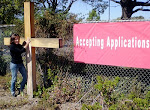
Which brings us to the curbside, outside Jericho. Jesus and the disciples are coming and going to and from Jericho. Contrast that to Bartimaeus whose blindness sandbags him on the curb outside city limits, not only because he cannot see but also because the authoritarian voices of his culture insist that being afflicted with blindness is evidence he or his family have done something terrible which renders him unworthy. He has no voice, no place.
But a flare of faith deep inside Bartimaeus rebells against the chorus of afflicting voices, “You are not good enough, not holy enough. How dare you speak up and admit the deepest desire of your heart?” because when he hears that Jesus of Nazareth is nearby somehow Bartimaeus musters his mettle and shouts above those sternly ordering him to be quiet, “Son of David, have mercy on me.”
His spirited shout stops Jesus in his tracks where he stands still and watches blind Bartimaeus spring to his feet and throw off his cloak. Without a hint of hesitation Bartimaeus cast off what was likely his only worldly possession as well as every limiting social proscription about who he was, a blind beggar with no place nor value in society who had no business calling out to the prophet, the Son of David. How dare he?
From our twenty-first century perspective blindness is a biomedical problem resulting in the sightless person’s inability to function. Healing involves restoring the person’s ability to function. Two thousand years ago in Palestine blindness is a social rather than biomedical problem, therefore healing involves being restored to a place in society. Throughout the Gospel according to Mark we meet Jesus as he heals people which restores them to a place in society.
Jesus heals a man with a dreaded skin disease, sends him to a priest to be ritually cleansed and return to community. (Mk 1.40-45)
Seeing the faith of folks who carry a paralyzed man to him, Jesus heals the man and sends him home. (Mk 2.1-12)
When a woman who had been bleeding for twelve years touches Jesus and is healed, it is her breaking the taboo about touching that heals her and Jesus affirms, “Your faith has made you well.” (Mk 5:25–34)
When townsfolk come to tell Jesus that Jairus’ daughter is dead he says, “Do not fear, only believe” and the child is healed. (Mk 5:21–42)
After touching and healing the blind man at Bethsaida Jesus sends him away to his home. (Mk 8:22–25)
The overarching message is, faith makes us well by restoring us to right relationship with God and community. When we choose to live by faith we are able to break through the physical, social, emotional and religious taboos that curb and constrain us, prohibiting us from participating in the fullness of life.
Belief or faith is kin to hope in the possibility of what can be. Belief or faith foster a kind of fearlessness that enables us to get off the curb at the side of the road, and boldly answer the question, “What do you want me to do for you?”
Do you dare to pause and admit the deepest desire of your heart? Are you willing to cast off all constraints that limit your idea of who and whose you are? Are you ready to live by faith and be restored to right relationship with your neighbors, the world and God? What do you want me to do for you?
If you found this post to be meaningful please share by clicking on icons below. Thank you.