Friday, October 4, 2019

Gospel text for Sunday 6 October 2019


Luke 17.5-10        The apostles said to the Lord, "Increase our faith!" The Lord replied, "If you had faith the size of a mustard seed, you could say to this mulberry tree, `Be uprooted and planted in the sea,' and it would obey you.

"Who among you would say to your slave who has just come in from plowing or tending sheep in the field, `Come here at once and take your place at the table'? Would you not rather say to him, `Prepare supper for me, put on your apron and serve me while I eat and drink; later you may eat and drink'? Do you thank the slave for doing what was commanded? So you also, when you have done all that you were ordered to do, say, `We are worthless slaves; we have done only what we ought to have done!’"

Reflection  Episcopalians never miss a beat with this familiar dialogue. “God is with you.” “And also with you.” But, what are we actually saying? I believe we are consenting to “with God” life. What that means is, we are consciously choosing to subordinate our personal self interest in order to advance Christ’s mission and ministry in the world. Essentially we are saying, “We are male or female servants, or slaves of Christ.” 

As “slaves” of Christ we are aligned in the will of God. This means, we are sincere when we pray, “Not my will, Your will be done.”  In this act of giving ourselves, our self interest away we are acknowledging that we are people who serve another. It does not matter if we are called disciples, apostles or pupils, attendants, devotees or servants, we are giving our selves over to God. We are essentially, the slaves of God.

Like our young sister Mary, we are asked to conceive of the utterly impossible; “uprooting and planting a mulberry tree in the sea,” lavishly give shelter to the homeless, food to the hungry, healing to the sick, wholeheartedly offer welcome to the stranger, freedom to the prisoner, love to the enemy, which all together add up to; unequivocally give birth to the presence of God with us. When we are asked to subordinate our personal self interest in order to advance Christ’s mission and ministry in the world, what is the first thing that comes to mind? “How can this be, since we are only human? The problems in our world are far beyond anything we can manage. This is too hard. There are too many homeless and hungry and sick, scores of strangers and prisoners and frightful enemies.” It is time to put down our protests and hear the words the Angel of God spoke to young Mary echoing in every cell and every space of our being, “For with God nothing will be impossible.”(Luke 1.37) With God. 

The little word “with” is rich with meaning in Biblical Greek. “Para” refers to something that proceeds from one's sphere of power, or from one's wealth. When we accept the Angel’s annunciation, “For with God nothing will be impossible,” we are affirming that with our will aligned in the will of God, all that proceeds through us is impregnated with the power and the wealth of God’s presence. With God, all things are possible. 

Without reluctance we confess, “We are worthless slaves; we have done only what we ought to have done,” because achreios, which in our text is translated ‘worthless,’ achreios is understood to be a hyperbolic reference to pious modesty. We humbly acknowledge that all the good that we do arises from the wealth and power of God’s presence with us. As slaves of Christ we call ourselves achreios, not deserving of merit, because we have done nothing more than what we ought to have done; lavishly give shelter to the homeless, food to the hungry, healing to the sick, wholeheartedly offer welcome to the stranger, freedom to the prisoner, love to the enemy, which all together add up to; unequivocally giving birth to the presence of God with us.  

 If you found this post to be meaningful please share by clicking on icons below. Thank You.


Tuesday, September 24, 2019

Epistle text for Sunday 29 September 2019


1 Timothy 6.6-19        There is great gain in godliness combined with contentment; for we brought nothing into the world, so that we can take nothing out of it; but if we have food and clothing, we will be content with these. But those who want to be rich fall into temptation and are trapped by many senseless and harmful desires that plunge people into ruin and destruction. For the love of money is a root of all kinds of evil, and in their eagerness to be rich some have wandered away from the faith and pierced themselves with many pains.

But as for you, man of God, shun all this; pursue righteousness, godliness, faith, love, endurance, gentleness. Fight the good fight of the faith; take hold of the eternal life, to which you were called and for which you made the good confession in the presence of many witnesses. In the presence of God, who gives life to all things, and of Christ Jesus, who in his testimony before Pontius Pilate made the good confession, I charge you to keep the commandment without spot or blame until the manifestation of our Lord Jesus Christ, which he will bring about at the right time-- he who is the blessed and only Sovereign, the King of kings and Lord of lords. It is he alone who has immortality and dwells in unapproachable light, whom no one has ever seen or can see; to him be honor and eternal dominion. Amen.

As for those who in the present age are rich, command them not to be haughty, or to set their hopes on the uncertainty of riches, but rather on God who richly provides us with everything for our enjoyment. They are to do good, to be rich in good works, generous, and ready to share, thus storing up for themselves the treasure of a good foundation for the future, so that they may take hold of the life that really is life.


Reflection        A few months ago a friend asked me, “Are you happy or are you content?” Although it was not meant to be a trick question, it gave me pause. So I spent about a week wondering, “What does it mean to be happy? What does it mean to be content?” Here is what occurs to me. 

Happy describes a transient emotional state associated with a particular moment or event; being pleased, delighted or feeling lucky because of something or someone. Content is an overall or generally pervasive condition of life, conveying a sense of sufficiency. Like the deep ocean currents that are stable and predictable, contentment is more of a constant or reliable undercurrent whereas happiness arises as a surface wave that ebbs and swells in response to the changing winds and tides of circumstance. The dependability of contentment engenders balance and a sense of freedom to be and enjoy life as it is. But, contentment is discouraged by our consumerist culture that insists there is always something more we need in order to be happy. 

When we kow-tow to the voice of consumerist culture, there is no way we can be content because we are bent on acquiring more happiness. And there is the dig. Consumerism sells happiness, a transient emotion that cannot be sustained no matter how much stuff or how many exotic adventures we acquire. Socrates writes, “Contentment is natural wealth, luxury is artificial poverty.” 

The trouble with luxury is it does not satisfy. It inevitably ebbs (or rusts, or breaks or the adventure simply ends) dissolving into a sense of loss or emptiness. Contentment, on the other hand, sustains. By focusing on the good things about our lives rather than on the next shiny thing, or what the neighbors have, or what we are told we are lacking, we can choose to be grateful. 

And there we arrive at the denouement. Choosing to be grateful for our life as it is, we are free, free to be and express our selves, free to enjoy life this moment.  Choosing to be grateful for our life regardless of how much stuff we do or do not have. Which brings us to the pastoral letter to Timothy, “There is great gain in godliness combined with contentment; for we brought nothing into the world, so that we can take nothing out of it; but if we have food and clothing, we will be content with these.” Being content we are free to affirm, we have just enough. 

If you found this post to be meaningful please share by clicking on icons below. Thank you. 


Saturday, September 21, 2019

Gospel text for Sunday, 22 September 2019

Luke 16:1-13        Jesus said to the disciples, "There was a rich man who had a manager, and charges were brought to him that this man was squandering his property. So he summoned him and said to him, `What is this that I hear about you? Give me an accounting of your management, because you cannot be my manager any longer.' Then the manager said to himself, `What will I do, now that my master is taking the position away from me? I am not strong enough to dig, and I am ashamed to beg.

 I have decided what to do so that, when I am dismissed as manager, people may welcome me into their homes.' So, summoning his master's debtors one by one, he asked the first, `How much do you owe my master?' He answered, `A hundred jugs of olive oil.' He said to him, `Take your bill, sit down quickly, and make it fifty.' Then he asked another, `And how much do you owe?' He replied, `A hundred containers of wheat.' He said to him, `Take your bill and make it eighty.' And his master commended the dishonest manager because he had acted shrewdly; for the children of this age are more shrewd in dealing with their own generation than are the children of light. And I tell you, make friends for yourselves by means of dishonest wealth so that when it is gone, they may welcome you into the eternal homes.

"Whoever is faithful in a very little is faithful also in much; and whoever is dishonest in a very little is dishonest also in much. If then you have not been faithful with the dishonest wealth, who will entrust to you the true riches? And if you have not been faithful with what belongs to another, who will give you what is your own? No slave can serve two masters; for a slave will either hate the one and love the other, or be devoted to the one and despise the other. You cannot serve God and wealth.”


Reflection        As children of this age, when focused on things of this world, (reviewing our bank statement or portfolios, church finances, considering our basic survival needs), we generally switch gears and leap into action when we see the need to take care of business. But, as children of light is this also true when we assess the state of our spiritual life? When  we notice things that can turn us away from God and the love of God’s people, (an inordinate concern for our portfolios and bank statements, our power and privilege), are we as swift to take action to preserve the light?

What do we mean, preserve the light? I believe it is the light of consciousness open to receive and radiate Jesus’ Good News; “God is with and for all people and we are all meant to experience fullness of life.” But everywhere we turn we are assaulted with contrary messages; “You better protect yourself, take care of number one, sure up your resources because life is a zero sum game. There is only so much money to go around, there are limits to the amount of power and privilege available, so grab what you can and protect it.”  Fearing we will be left out or left behind, we leap into action, accumulate as much as possible and then worry about protecting our earthly assets with smart houses and corporate veils, electric fences, umbrella insurance and off shore accounts. 

Then in a twist we don’t see coming, Jesus commends the manager who rips off his rich master,  when the manager “acts shrewdly” to insure his own survival. What is going on here? Even though the unjust manager is reducing the debtors’ debt for his personal gain, he is using money to benefit his neighbors and establish friendships so they will “welcome him into their homes.“Ironically, this secures the unjust manager’s spiritual life because our spiritual life is all about relationships, not about protecting number one.

There is nothing inherently wrong with money or power or privilege. And yes, to some extent they do provide us with physical and social security. But, no amount of money, power or privilege puts us in right relationship with God. No superfund of resources can protect us from travail and ultimately, death. So, the question is, how are we using our resources? 

Are we fools who use our resources in an ill-fated effort to secure our physical and social security and consequently crash into a wall of our own making, an edifice of ‘stuff’ separating us from God and God’s people? Or, are we using our money, power and privilege to establish good will and cultivate community for the glory of God? Are we only children of the age or are we also children of the light?

If you found this post to be meaningful please share by clicking on icons below. Thank you.


Friday, September 13, 2019

Gospel text for Holy Cross Day, 14 September 2019

John 12:31-36a        Jesus said, “Now is the judgment of this world; now the ruler of this world will be driven out. And I, when I am lifted up from the earth, will draw all people to myself.” He said this to indicate the kind of death he was to die. The crowd answered him, “We have heard from the law that the Messiah remains forever. How can you say that the Son of Man must be lifted up? Who is this Son of Man?” Jesus said to them, “The light is with you for a little longer. Walk while you have the light, so that the darkness may not overtake you. If you walk in the darkness, you do not know where you are going. While you have the light, believe in the light, so that you may become children of light.”

Reflection        Let’s consider this gospel text in context. After raising Lazarus from the dead, and doing many other signs, Jesus enters Jerusalem in anticipation of the great festival days. A large crowd greets him, waving branches and saying, “Hosanna, blessed is the one who comes in the name of the Lord.” We memorialize this moment in the celebration we now call Palm Sunday. 

At the same time, tension is mounting among religious and political officials who are infuriated because, “the world has gone after Jesus.” (John 12.19) They are losing control and Jesus must be eliminated. Reading the handwriting on the wall, Jesus could run away, but instead he utters, “Now my soul is troubled. And what should I say, Father save me from this hour? No, it is for this reason that I have come to this hour. “ (John 12. 27) 

Then something happens that we tend to overlook. A voice comes from heaven. Some folks think it is thunder, others, an angel. Jesus explains, “This voice has come so you will understand my death.” Here we come face to face with the great enigma, the problem of the cross. 

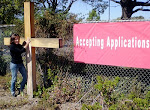
Two thousand years ago in Jerusalem the most barbaric and humiliating way to die was to be nailed to a cross, lifted up and left to slowly suffocate. This dreadful fate was reserved for the worst criminals. Yet Jesus instructs the crowds to believe him, that he will be lifted up on the cross in glory. The instrument of inhumane death will be the means of glory. How can this be?

I believe the passage from An Ignatian Book of Days,*”  September 15th, “Suffering With Others” helps us understand the glory of the cross.

“When we cannot change a situation we are tempted to walk away from it. We might literally walk away: we are too busy to sit with a suffering friend. Or we walk away emotionally: we harden ourselves and maintain an emotional distance. We might react to the gospel accounts of Jesus’ passion and death this way. They describe something terrible and horribly painful, yet we might shield ourselves from the pain… Ignatius wants us to experience the Passion as something fresh and immediate. We learn to suffer with Jesus and thus learn to suffer with the people in our lives.” (266) 

Later in the gospel according to John we read, “This is my commandment, that you love one another as I have loved you. No one has greater love than this, to lay down one’s life for one’s friend.” (John 15.12-13) Saying yes to the present moment, no matter how grim it looks, suffering with others regardless of how much it costs, this is lifting up the cross, this is the means of glory. 

Please listen to Peter Gabriel's soundtrack (upper right corner of blog). It accompanies the Passion. Imagine suffering with Jesus or a friend.

If you found this post to be meaningful please share by clicking on icons below. Thank you. 

Manney, Jim. Loyola Press (Chicago, IL., 2014).

Thursday, September 5, 2019

Gospel text for Sunday 8 September 2019

Luke 14:25-33        Now large crowds were traveling with Jesus; and he turned and said to them, "Whoever comes to me and does not hate father and mother, wife and children, brothers and sisters, yes, and even life itself, cannot be my disciple. Whoever does not carry the cross and follow me cannot be my disciple. For which of you, intending to build a tower, does not first sit down and estimate the cost, to see whether he has enough to complete it? Otherwise, when he has laid a foundation and is not able to finish, all who see it will begin to ridicule him, saying, `This fellow began to build and was not able to finish.' Or what king, going out to wage war against another king, will not sit down first and consider whether he is able with ten thousand to oppose the one who comes against him with twenty thousand? If he cannot, then, while the other is still far away, he sends a delegation and asks for the terms of peace. So therefore, none of you can become my disciple if you do not give up all your possessions.”

Reflection        The cost of responding to Jesus’ invitation to discipleship, the cost of actually living the Way of Jesus, insists we break away from the past and from all attachments that would stand between us and living in imitation of Jesus. In his 1937 classic, The Cost of Discipleship,  the German theologian Dietrich Bonhoeffer writes,

"The price we are having to pay today in the shape of the collapse of the organized church is only the inevitable consequence of our policy of making grace available to all at too low a cost. We gave away the word and sacraments wholesale, we baptized, confirmed, and absolved a whole nation without condition. Our humanitarian sentiment made us give that which was holy to the scornful and unbelieving…  But the call to follow Jesus in the narrow way was hardly ever heard.”**

Which begs the question, what is ‘the narrow way” of following Jesus? I believe it is picking up the cross and imitating the life of Jesus. And what does that mean? It means, like Jesus we must be willing to suffer or sacrifice for the sake of others. You see, Jesus did not come as a warrior king, intent on fighting the purveyors of evil and oppression and winning. Jesus did not come as a politician seeking office to govern the land and legislate change and take over. Jesus did not even come as a stakeholder in Judaism or the Roman Empire. Jesus came as a powerless peasant willing to empty himself of all attachments in order to serve and to suffer for the good of others. This is the cost of discipleship, our whole life.

It is in our willingness to advance benefits for others even at our own expense; to feed the hungry, house the homeless, give refuge to the stranger, comfort the mourning and heal the sick that we are the bodily presence of Christ in the world. If we claim to be disciples of Jesus then we too must empty ourselves of attachments, in Jesus’ words, “hate father and mother, wife and children, brothers and sisters, yes, and even life itself,”  in order to serve and to suffer for the good of others. This is the cost of discipleship.

Doing good works has its shadow side too. There is always the temptation to elevate ourselves. “Look at me. Do you see all the good I am doing? I help the homeless at Sr. José, I serve the refugees at Casa Alitas, I help my neighbors, I bring groceries to the food pantry…” The good works that we do are not intended to point to ourselves. They are meant to reveal Divine Presence and fulfill Jesus’ law of love for all people. By our self-emptying, our giving away of ourselves for others, we are the living Body of Christ and we reveal the Way of the cross to the world, and, there is absolutely nothing easy about this. The cost of discipleship is our life.

**Bonhoeffer, Dietrich. The Cost of Discipleship. New York: Macmillan, 1966. BT 380.B66 1966.

If you found this post to be meaningful please share by clicking on icons below. Thank you. 


Friday, August 30, 2019

Collect and Gospel text for Labor Day 1 September 2019


Collect for Labor Day       Almighty God, you have so linked our lives one with another that all we do affects, for good or ill, all other lives: So guide us in the work we do, that we may do it not for self alone, but for the common good; and, as we seek a proper return for our own labor, make us mindful of the rightful aspirations of other workers, and arouse our concern for those who are out of work; through Jesus Christ our Lord, who lives and reigns with you and the Holy Spirit, one God, for ever and ever. Amen.


Matthew 6:19-24        Jesus said, "Do not store up for yourselves treasures on earth, where moth and rust consume and where thieves break in and steal; but store up for yourselves treasures in heaven, where neither moth nor rust consumes and where thieves do not break in and steal. For where your treasure is, there your heart will be also.

"The eye is the lamp of the body. So, if your eye is healthy, your whole body will be full of light; but if your eye is unhealthy, your whole body will be full of darkness. If then the light in you is darkness, how great is the darkness! "No one can serve two masters; for a slave will either hate the one and love the other, or be devoted to the one and despise the other. You cannot serve God and wealth.”


Reflection      Is it not interesting how well the words attributed to Jesus in the gospel according to Matthew, “The eye is the lamp of the body. So, if your eye is healthy, your whole body will be full of light, but if you eye is unhealthy, your whole body will be full of darkness…” are aligned with the words of modern day quantum physicists as quoted from Quantum Revelation: A Radical Synthesis of Science and Spirituality?*

“We live in a self observing universe where we are the instruments through which the universe becomes aware of its creative nature. The question then becomes: How do we hold up a mirror to ourselves when we ourselves are the  mirror? For we are simultaneously the mirror, the light it reflects, and the eyes that see the reflection. Everything is part of one unified quantum system with no separation to be found anywhere.” (p 60-61)

Does this scientist not echo the wisdom born on the lips of the Collect (Prayer) for Labor, “Almighty God, you have so linked our lives one with another that all we do affects, for good or ill, all other lives?”  There is no separation. All that is, and this includes all people, creatures and black holes, is One, interconnected, interdependent unity (not uniformity).

There being no separation, we can no longer rely on or trust our habit of dualistic thinking; forcing things into discrete categories of good/bad, right/wrong, true/false, us/them. As we stretch beyond a black/white perspective we engage the complex nuance of ten thousand shades of grey, ten thousand thousand subtle shades that constitute the unity of all things. 

Considered in the context of all that is, we humans are at once infinitesimal and absolutely essential. In their textbook on quantum theory the authors tell this story.

“An old legend describes a dialogue between Abraham and Jehovah. Jehovah chides Abraham, “You wound not even exist if it were not for me!” “Yes Lord, that I know,” Abraham replies, “but also You would not be known if it were not for me.”**

How do we humbly take responsibility for the fact “that all we do affects, for good or ill, all other lives?” How shall we remain mindful that when we light a candle it heats the world? When we breath hatred we foster hostility? When we bless we invoke happiness? When we vilify we call down fear? When we compliment we commend honor? When we are covetous we diminish life? When we are benevolent everything grows?

In the past we heard debates; science v.s. spirituality. Today’s science breathes life into spirituality with words such as these.
“And then at last an inspiration: a feeling that we who felt ourselves so small amidst it all are, in the end, the carriers of the central jewel, the flashing purpose that lights up the whole dark universe.”* (p 75)

  • Levy, Paul Quantum Revelation: A Radical Synthesis of Science and Spirituality? Levy suggests the study of the universe and human consciousness are inseparably linked. 
        **Wheeler and Zurek, Quantum Theory and Measurement, 197.    Artwork by Alex Grey

If you found this post to be meaningful please share by clicking on icons below. Thank you. 

Friday, August 23, 2019

Gospel text for Sunday 25 August 2019

Asylum Seeking Families 
Welcomed to freedom and rest in Tuscon's new Casa Alitas Welcome Center

Luke 13:10-17        Now Jesus was teaching in one of the synagogues on the sabbath. And just then there appeared a woman with a spirit that had crippled her for eighteen years. She was bent over and was quite unable to stand up straight. When Jesus saw her, he called her over and said, "Woman, you are set free from your ailment." When he laid his hands on her, immediately she stood up straight and began praising God. But the leader of the synagogue, indignant because Jesus had cured on the sabbath, kept saying to the crowd, "There are six days on which work ought to be done; come on those days and be cured, and not on the sabbath day." But the Lord answered him and said, "You hypocrites! Does not each of you on the sabbath untie his ox or his donkey from the manger, and lead it away to give it water? And ought not this woman, a daughter of Abraham whom Satan bound for eighteen long years, be set free from this bondage on the sabbath day?" When he said this, all his opponents were put to shame; and the entire crowd was rejoicing at all the wonderful things that he was doing.

Reflection         Observe the sabbath day and keep it holy, as the Lord your God commanded you. For six days you shall labour and do all your work. But the seventh day is a sabbath to the Lord your God; you shall not do any work—you, or your son or your daughter, or your male or female slave, or your ox or your donkey, or any of your livestock, or the resident alien in your towns, so that your male and female slave may rest as well as you. Remember that you were a slave in the land of Egypt, and the Lord your God brought you out from there with a mighty hand and an outstretched arm; therefore the Lord your God commanded you to keep the sabbath day.” (Deuteronomy 5:12-15)

Keeping the Sabbath holy means extending freedom and compassion to all people and all creatures; ox, donkeys, livestock, resident aliens and slaves. No one is to be denied rest, peace, dignity and freedom, even if it is only temporary. Apparently Jesus felt an urgency to fulfill this God given mandate. Offering healing to the long suffering woman could not wait until Saturday night. Jesus is living according to the spirit of God’s law.

I suspect Jesus calls the leader of the synagogue a hypocrite because in the leader’s dogged adherence to the letter of the law he has lost sight of the spirit of the law. If the root of the law is affirmation of the holiness of life and that everyone deserves to be set free, then what possible justification could there be to allow anyone or anything to suffer by being bound, or tied, to the letter of the law? Sometimes we simply cannot wait to do what is right.

This week I received a letter from the Rev. Delle McCormick, retired UCC minister, describing her experience meeting one mother and her daughter at the Casa Alitas Welcome Center, the Tucson site for hosting the newest asylum seeking guests to our country. Rev. McCormick writes,  “The single mom from Guatemala had a college degree, a "good job" with the Ministry of Education. One day after work she was met getting off the bus by a person who ordered her to deliver two "packages." She declined, knowing the packages most likely contained drugs or weapons. The next day when she got off the bus, the same man handed her a picture of her 4 year-old daughter, and said the child would be dead the next day if she didn't deliver the packages. That night, the mom left her job, her bank account, her home, her family, her culture - her whole life, she said - and fled, taking three weeks to make her way with her daughter to the US border. Sitting before me was a person who, without notice, left her whole life behind for the sake of her daughter. Imagine.” *

Sometimes we simply cannot wait to do what is right.

This Guatemalan mother broke who knows how many laws, laws constructed with good intentions to support and protect people and nations.  Nonetheless, can you see Jesus reaching out to help this woman? Can you hear him saying to officials who are swift to remind him of all the laws she has broken and that he too is breaking the law by helping her, "You hypocrites! Would not each of you leave your career, your home, your bank account, your country, everything you know to save the life of your child? And ought not this woman, a daughter of Abraham whom Satan bound with threats to the life of her child, be set free from this bondage, on the sabbath or any other day of the week?”

Luke’s text invites us into a complicated conversation. A conversation with which we cannot cease to wrestle. How do we live between the letter and the spirit of the law? Which laws assist us in leading a Christian life? If we believe the root of the law is affirmation of the holiness of life and that everyone deserves to be set free, what actions shall we choose to put flesh on the bones of God’s law today? Compassion cannot wait. 

  • Visit ccs-soaz.org. for more information about Casa Alitas Shelter Programs


If you found this post to be meaningful please share by clicking on icons below. Thank you.