Showing posts with label death. Show all posts

Saturday, March 24, 2018

Gospel text for Sunday of the Passion 25 March 2018


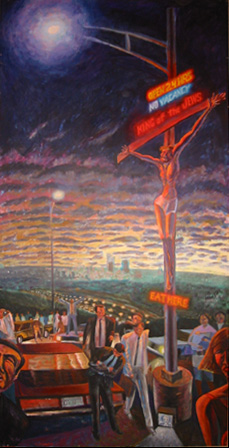
Mark 15.1-39         As soon as it was morning, the chief priests held a consultation with the elders and scribes and the whole council. They bound Jesus, led him away, and handed him over to Pilate. Pilate asked him, “Are you the King of the Jews?” He answered him, “You say so.” Then the chief priests accused him of many things. Pilate asked him again, “Have you no answer? See how many charges they bring against you.” But Jesus made no further reply, so that Pilate was amazed.

Now at the festival he used to release a prisoner for them, anyone for whom they asked. Now a man called Barabbas was in prison with the rebels who had committed murder during the insurrection. So the crowd came and began to ask Pilate to do for them according to his custom. Then he answered them, “Do you want me to release for you the King of the Jews?” For he realized that it was out of jealousy that the chief priests had handed him over. But the chief priests stirred up the crowd to have him release Barabbas for them instead. Pilate spoke to them again, “Then what do you wish me to do with the man you call the King of the Jews?” They shouted back, “Crucify him!” Pilate asked them, “Why, what evil has he done?” But they shouted all the more, “Crucify him!” So Pilate, wishing to satisfy the crowd, released Barabbas for them; and after flogging Jesus, he handed him over to be crucified.

Then the soldiers led him into the courtyard of the palace (that is, the governor’s headquarters); and they called together the whole cohort. And they clothed him in a purple cloak; and after twisting some thorns into a crown, they put it on him. And they began saluting him, “Hail, King of the Jews!” They struck his head with a reed, spat upon him, and knelt down in homage to him. After mocking him, they stripped him of the purple cloak and put his own clothes on him. Then they led him out to crucify him.
They compelled a passer-by, who was coming in from the country, to carry his cross; it was Simon of Cyrene, the father of Alexander and Rufus. Then they brought Jesus to the place called Golgotha (which means the place of a skull). And they offered him wine mixed with myrrh; but he did not take it. And they crucified him, and divided his clothes among them, casting lots to decide what each should take.

It was nine o’clock in the morning when they crucified him. The inscription of the charge against him read, “The King of the Jews.” And with him they crucified two bandits, one on his right and one on his left. Those who passed by derided him, shaking their heads and saying, “Aha! You who would destroy the temple and build it in three days, save yourself, and come down from the cross!” In the same way the chief priests, along with the scribes, were also mocking him among themselves and saying, “He saved others; he cannot save himself. Let the Messiah, the King of Israel, come down from the cross now, so that we may see and believe.” Those who were crucified with him also taunted him.

When it was noon, darkness came over the whole land until three in the afternoon. At three o’clock Jesus cried out with a loud voice, “Eloi, Eloi, lema sabachthani?” which means, “My God, my God, why have you forsaken me?” When some of the bystanders heard it, they said, “Listen, he is calling for Elijah.” And someone ran, filled a sponge with sour wine, put it on a stick, and gave it to him to drink, saying, “Wait, let us see whether Elijah will come to take him down.” Then Jesus gave a loud cry and breathed his last. And the curtain of the temple was torn in two, from top to bottom. Now when the centurion, who stood facing him, saw that in this way he breathed his last, he said, “Truly this man was God’s Son!”

Reflection       Each one of our stories is a variation on the theme of Jesus’ story. Some of us were planned from birth, others, not so much. Some were welcomed to the world with gifts, (if not frankincense and myrrh, perhaps a silver spoon) others driven into hiding. All of us encounter “other” people; the sick, wealthy, poor, wise, powerful, weak, fearful, bold. A few of us have friends who really know who we are but most people only think they do. We have families who love us and misjudge us; civil and religious officials who try to tell us who and how we ought to be. And, if we dare to pick up our cross and live our lives by faith rather than fear, if we dare to strive for love and compassion rather than power and privilege, there is every chance we will be misunderstood, hated, persecuted and likely hear ourselves cry out, “My God, my God, why have you forsaken me?” 
Here is the thing. As we progress on our journeys of faith with God, sometimes God seems to be absent especially if we have experienced moments of joy, comfort or great consolation with God. Experiencing the presence of God with us is like fueling our deepest desire, and of course, all we want is more, more of the amazing God feeling. So God, in God’s wisdom steps back, inviting us into deeper, more faithful relationship with God, a relationship that does not depend on signs,  miracles, good feelings or even rescue from suffering or death.
We share this story that we call life with Jesus. Woven throughout our stories there are paragraphs called suffering and others called death because our lives are punctuated  with all kinds of suffering and who knows how many deaths; deaths of our self image, ego, ideals, youth, dreams, deaths of our pets and loved ones, death of the way things used to be, until our physical death. 
There is no superhero God who is going to break into space and save us from suffering and death. But the good news is,  Jesus shows us the way to navigate these paragraphs with grace and equanimity. Rather than praying for divine rescue or miraculous cure we look to the presence of God who is faithfully with us, no matter what because God is faithful. 
The curtain that separated the divine from the human has been torn for ever. As the apostle Paul wrote to the Christians in Rome, “For I am convinced that neither death, nor life, nor angels, nor rulers, nor things present, nor things to come, nor powers, nor height, nor depth, nor anything else in all creation, will be able to separate us from the love of God…” (Ro 8.38-39) God is faithful, no matter what.
May your walk to Jerusalem be blessed this Holy Week and always.

If you found this post to be meaningful please share by clicking on icons below. Thank you. 

Saturday, September 24, 2016

Gospel text for Sunday 25 September 2016

Luke 16:19-31        Jesus said, "There was a rich man who was dressed in purple and fine linen and who feasted sumptuously every day. And at his gate lay a poor man named Lazarus, covered with sores, who longed to satisfy his hunger with what fell from the rich man's table; even the dogs would come and lick his sores. The poor man died and was carried away by the angels to be with Abraham. The rich man also died and was buried. In Hades, where he was being tormented, he looked up and saw Abraham far away with Lazarus by his side. He called out, `Father Abraham, have mercy on me, and send Lazarus to dip the tip of his finger in water and cool my tongue; for I am in agony in these flames.' But Abraham said, `Child, remember that during your lifetime you received your good things, and Lazarus in like manner evil things; but now he is comforted here, and you are in agony. Besides all this, between you and us a great chasm has been fixed, so that those who might want to pass from here to you cannot do so, and no one can cross from there to us.' He said, `Then, father, I beg you to send him to my father's house-- for I have five brothers-- that he may warn them, so that they will not also come into this place of torment.' Abraham replied, `They have Moses and the prophets; they should listen to them.' He said, `No, father Abraham; but if someone goes to them from the dead, they will repent.' He said to him, `If they do not listen to Moses and the prophets, neither will they be convinced even if someone rises from the dead.'"
Reflection      Three dead men. One wisdom tale. What is Jesus up to? Every hour of every day Lazarus dies a bit more as dogs lick his wounds until at last the unfathomable happens, “The poor man …. is carried away by the angels to be with Abraham.” Meanwhile the rich man lives in the lap of luxury; well fed and dressed in Tyrian purple, an expensive dye extracted from shellfish first produced by the Phoenician city of Tyre two thousand years before Jesus walked to Jerusalem. By all measures the man wearing purple is the image of success until he dies, is given a proper burial, and the  unfathomable happens; he finds himself irredeemably tormented, separated from Abraham by an impassable chasm.

Which leads us to the third dead man, Abraham, Father of Judaism, Christianity and Islam, whose hospitality and generosity are immortalized in the tale of him lavishly entertaining three strangers, angels in disguise.(Gen 18.2-8) Like the rich man in Jesus’ parable, Abraham is a wealthy man. Unlike the rich man in purple whose actions are singularly self-serving, Abraham is generous and acts for the good of others. When the rich man wearing purple dies and sees Lazarus with Abraham, he does not pause to reflect on his actions, how day after day he ignored suffering Lazarus, he does not ask for forgiveness nor turn around to amend his ways. Instead, the self-important man still tries to wield power over Lazarus to get a sip of comfort. 

I believe it is the rich man’s attitude of entitlement ( not his wealth) that is the source of his torment. His singular concern with his security, safety, status, esteem, power and control makes it impossible for him to connect with the generosity and hospitality of God as embodied by Abraham. It is the rich man’s attitude, his frame of mind, that prevents him from being in right relationship with God or anyone else.

By contrast Abraham is the exemplar of what living in right relationship with God looks like. In fact, Christianity, Judaism and Islam stand together affirming Abraham as the earthly expression of God’s instruction that people who enjoy power, privilege and resource are to care for the powerless, the poor and the needy. This is what bridges the gap between the rich and the poor. This is what God’s economy looks like. 

Which begs the question, what are we doing to redistribute the power, privilege and resource we are freely given to provide for those with so much less? What are we doing to insure there is no chasm between God’s boundless generosity and ours? 


If you found this post to be meaningful please share by clicking on icons below. Thank you.

Monday, October 22, 2012

Gospel text Sunday 28 October 2012


Mark 10:46-52      Jesus and his disciples came to Jericho. As he and his disciples and a large crowd were leaving Jericho, Bartimaeus son of Timaeus, a blind beggar, was sitting by the roadside. When he heard that it was Jesus of Nazareth, he began to shout out and say, "Jesus, Son of David, have mercy on me!" Many sternly ordered him to be quiet, but he cried out even more loudly, "Son of David, have mercy on me!" Jesus stood still and said, "Call him here." And they called the blind man, saying to him, "Take heart; get up, he is calling you." So throwing off his cloak, he sprang up and came to Jesus. Then Jesus said to him, "What do you want me to do for you?" The blind man said to him, "My teacher, let me see again." Jesus said to him, "Go; your faith has made you well." Immediately he regained his sight and followed him on the way.
Reflection                                                                                              Have you ever felt restless or apprehensive, that things were just not right? A bit off center, uneasy, unclear making it hard to stand up and move on? I certainly have and I experience it as a kind of spiritual blindness. Although I have eyes to see the world around me, somehow I do not understand what is going on. I am spiritualy blind. In my blindness the best I can do is sit at the side of the road not sure which way to go. In the absence of self understanding where can I possibly go? When I do try to move I falter and stumble because, though I have eyes, I do not see. What is this unsettling mystery that is so difficult for me and the disciples in Mark’s gospel to see?
I believe this may have something to do with why the writer of Mark’s gospel tells the stories of  the blind man in Bethsaida and blind Bartimaeus and places them like bookends before the first and following the third time Jesus predicts his suffering, death and resurrection. The thing is, who can understand the mystery of Jesus, fully human and fully divine? Who can understand the mystery of a messiah whose glory is born in his consent to drink the cup of suffering and death? Who can understand the message that the last shall be first and the least shall be greatest? How can I follow Jesus if I am blind and do not understand? 
The best I can muster is joining blind Bartimaeus shouting, “Lord have mercy on me! I don’t understand and I don’t know which way to go. I am sitting on the curb watching life pass by because if I stand in my own power I will stumble and fall. Teacher, have mercy on me. Please call me and show me which way to go.”
Maybe it is all in that one word, teacher. When I call out asking for  the teacher’s mercy I am admitting that I do not know. I am making myself least in the relationship. From the position of open, empty receptivity I am ready and waiting for the teacher to pass by and call me. I am not so full of my self or my plans that I cannot see or hear the teacher call. That’s where I am today. Sitting on the curb with blind Bartimaeus. Though I am still uneasy I sit in faith with hope that the teacher will call, restore my sight and  show me the way.


Tuesday, August 23, 2011

Gospel Text for Sunday, August 28th, 2011


Matthew 16. 21-28 Jesus began to show his disciples that he must go to Jerusalem and undergo great suffering at the hands of the elders and chief priests and scribes, and be killed, and on the third day be raised. And Peter took him aside and began to rebuke him, saying, "God forbid it, Lord! This must never happen to you." But he turned and said to Peter, "Get behind me, Satan! You are a stumbling block to me; for you are setting your mind not on divine things but on human things."


Then Jesus told his disciples, "If any want to become my followers, let them deny themselves and take up their cross and follow me. For those who want to save their life will lose it, and those who lose their life for my sake will find it. For what will it profit them if they gain the whole world but forfeit their life? Or what will they give in return for their life?


"For the Son of Man is to come with his angels in the glory of his Father, and then he will repay everyone for what has been done. Truly I tell you, there are some standing here who will not taste death before they see the Son of Man coming in his kingdom."